
Prefill Cache
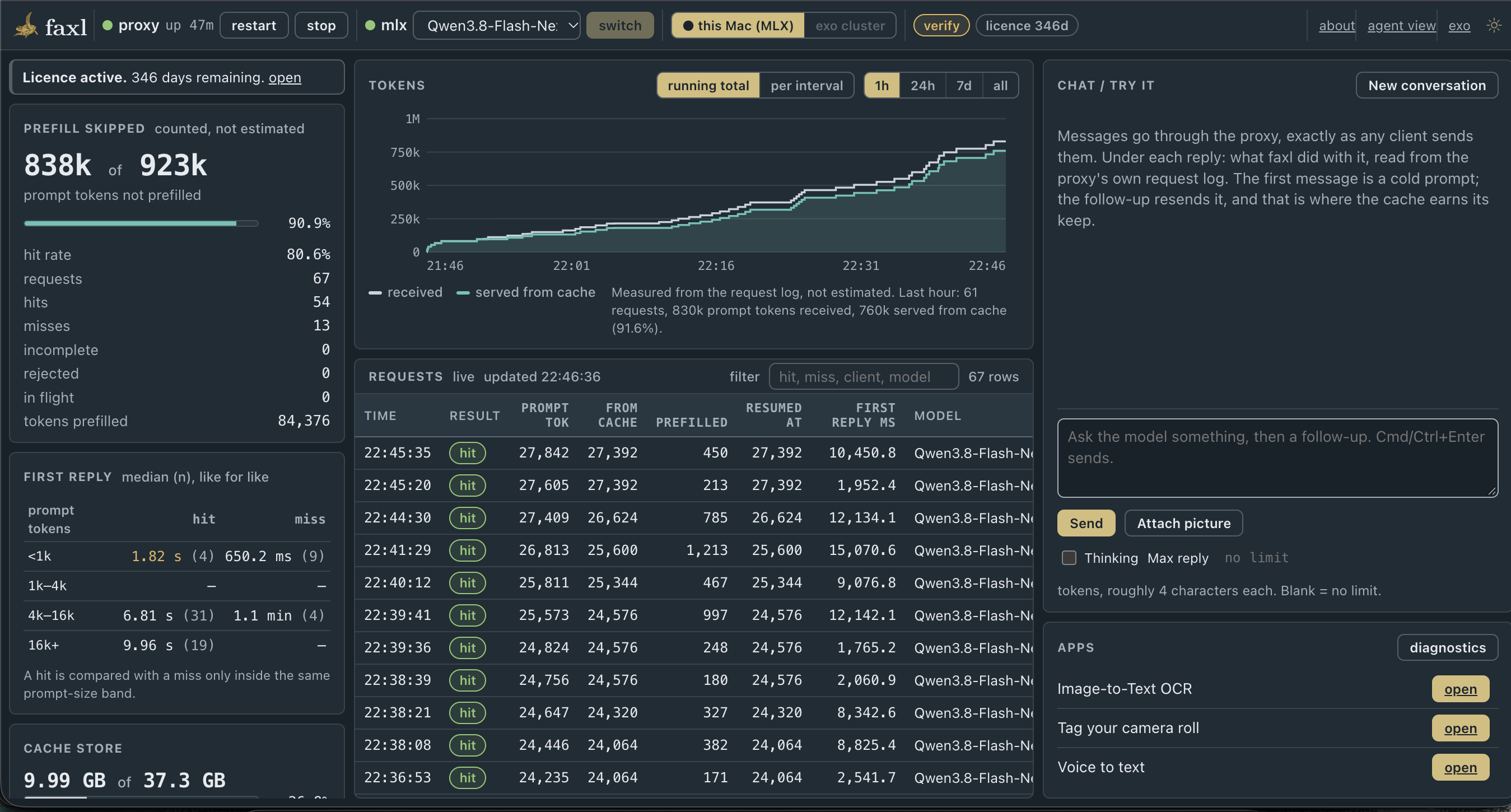
faxl delivers SSD based prefill cache
We've developed caching technology for local AI that moves prefill cache to SSD, delivering cheap, effective caching that survives reboots, supports long-running periodic agentic workloads, and helps you control your token burn. In many cases, it turns local AI from being a fun experiment to becoming a realistic tool that gets real work done.
Why faxl
What is an agent?
Hidden from you, AI agents are made of hundreds of engineered prompts. They define its personality, its moral code. Its soul. Each prompt you send is wrapped in that template. "Good morning Hal" can burn 100k tokens. Agentic automation expands the templates. It requires bigger prompts to get consistent results. Examples, skills, domain knowledge, compacted history, rules, style guides, reminders — all of these wrap every call you make.
The cost
Local AI demands good prefill caching
Using Local AI on constrained hardware can be slow. The way to make it faster is to cache all those templates. It's called a "Prefill Cache" — it cuts time to first token and gpu effort by up to 90%. Today's prefill caches are designed for datacentre GPUs with huge amounts of ram, but faxl is designed for you. It stores the cache on local disk.
Disk is cheap and moving cache to disk means you control the cache directly.
faxl
The missing piece
faxl is the software you need to run your own caching layer, in front of your own models. On an agentic coding session it skips 98% of prompt tokens and returns the whole session 4.4× faster, byte-for-byte identical. You manage it as you see fit. It lets you leave the cloud services and go private.
Measured
What it does, on real traffic
Measured 9 October 2026 on a 128 GB MacBook Pro (M3 Max), Qwen3.6-35B-A3B-4bit: eight turns of an agent reading files, searching, running tests and editing code, with tool results carried forward. The cold arm is a store cleared immediately beforehand, so it is what a first-ever session really costs. Repeated on Qwen3.8-Flash-Next-OptiQ-2bit: 98.1% skipped, 3.1× faster, 8/8 identical. Your result depends on how much your prompts repeat. faxl helps when prompts share long prefixes: system prompts, RAG preambles, document Q&A, agent loops. If yours do not, faxl gives you the analytics to work out how to reorganise your agentic prompts — to engineer them, and take control of your performance.
Today
Apple silicon now, NVIDIA next
faxl runs on a Mac with an M-series chip via MLX — including a Mac Studio you have already bought and are not getting full use of. It also runs across several Macs over Thunderbolt, which is how you run a model too large for any one of them. The NVIDIA/vLLM port passes the same byte-identity bars on GPU.
Free for noncommercial use: a named licence, valid 3 months, renewed free by signing up again.
Get faxl — free